David Sheets Long-Form Final

David Sheets

3/31/20
Tesla, Inc: Leading the Charge into the Electric Car Revolution

The Ecosystem 

Tesla Inc. has surpassed all electric car companies in sales each year since 2018. You may wonder what separates Tesla’s electric cars from those of its competitors. Specifically, Tesla has an advantage foundationally over competing car companies in that they do not carry the weight of having to create gasoline cars. You can think of this as a head start that Tesla has over competing gasoline car companies that are only recently beginning to create electric cars.

For Tesla, all of their focus and attention is on constructing the best electric car in the market. As Richard Jordan, the President of the Tesla Owners of Connecticut club, put it, “Tesla has built a car from the ground up to be an electric car.” 

As Jordan explained, many competing car brands that sell both electric and gas-powered cars are hedging their bets. 

“The other car companies are so ingrained in making internal combustion engine car bodies that their building them for dual purpose. If the electric car thing doesn’t pan out, they can still use the bodies to make gas cars,” he said.

“It’s a mindset,” Jordan continued. “It’s just their train of thought, they don’t think of making things super light, more aerodynamic,” he added.

Tesla, from its inception in 2008, is strictly an all-electric automobile company. This means none of their attention in designing vehicles is bogged down by traditional gasoline car considerations.

Richard Jordan referred to it as “the ecosystem” surrounding Tesla as a company. Similar to the reasons consumers are attracted to Apple as a brand, Tesla pulls car owners in with more benefits than just energy efficiency and electricity. 

“Not only is it the car that people really like, It’s Tesla as a company,” Jordan said. “They make cars fun to own, the easter eggs, romance mode. The center screen turns into a fireplace and the heat cranks up to 95 degrees.” 

“It’s just goofy, stupid shit. It’s the brand, why not have it be fun,” he added.

The Software & Features

It’s not just the goofy shit, either. The fact that the entire car operates on a touchscreen tablet that receives periodic software updates means that the performance and efficiency of your Tesla can improve over time. This is yet another parallel to the atmosphere surrounding Apple products which also receive performance boosting updates to their operating software.

“My car accelerates faster,” Jordan said. “It’s not a placebo effect either, it wasn’t psychological.” 

After a software update, Jordan noticed that the car was more responsive to his touch on the accelerator. This makes sense considering these functionalities are determined by the responsiveness of the software in the car. In essence, the Tesla you buy today can improve over time through free, over-the-air software updates.

Professor Kent Golden has also received free performance boosting software updates to his Model 3.

 “It is not an exaggeration to say that literally my car is better now than it was two weeks ago, and a year ago. They are continually improving it,” he said.

“It’s weird to think about because we’re used to buying cars that, when you buy it, that’s as good as it’s gonna get. It just degrades after that without an aftermarket upgrade,” he added. 

Professor Golden’s Tesla Model 3 has gotten better on a monthly basis since he’s gotten it, including 24 more horsepower added just a few weeks ago. He didn’t have to pay anything for it, he just downloaded an update and now his car has more power. 

He also received multiple software updates including features like Self Driving and Smart Summons. So yes, one day his car couldn’t drive itself, the next day it could. 

“That’s just part of the experience of owning a Tesla car. They just want it to be the best car possible,” Professor Golden added.

Tesla’s Technological Revolution

“Every once and a while a revolutionary product comes along that changes everything.” 

This much was obvious for Steve Jobs as he opened with this remark while unveiling Apple’s first iPhone in 2007. For Jobs, the multi touch glass display on the iPhone and choice to do away with the physical keyboard on smartphones revolutionized personal devices. 

Jobs knew he had something special: An innovative take on an existing product at an affordable cost. 

The similarities between the beginning of Apple’s iPhone and the emergence of the Tesla electric car are striking. Not only did both companies dive headfirst into industries with bloodthirsty competitors, but they both attacked their rivals from new angles. Both Apple and Tesla lured away consumers with new technologies and affordable benefits that other companies had not yet offered.

It’s becoming increasingly obvious that Tesla, Inc. is emerging as the electric car brand of the future. That much was apparent even before the release of Tesla’s new Cybertruck. The design is oddly simplistic, and yet strikingly futuristic. It’s also controversial.

Twitter users did not hold back on their opinions of the Cybertruck design, with large companies like LEGO even getting in on the trolling.

https://wke.lt/w/s/31Ef1i

Yet, Tesla’s intentions with the Cybertruck design may be more well thought out than they seem. A simplistic, mostly metallic, and futuristic look dawns the first Cybertruck. Tesla is trying to make a statement that they represent the future of the electric car, in technology and in design.

The reaction is reminiscent to the initial shock of the design of the first iPhone. Very few buttons, and a software-based operating system controlled by a touchscreen control center. 

By catapulting itself into the pickup truck industry, Tesla is entering an entirely new atmosphere with a loyal consumer base. They need a reason to switch from the brands they love. As Tesla may soon find out, now may be a good time to offer something completely new to pickup truck owners. 

CarGurus conducted “The 2019 Truck Sentiment Survey” that found that 68% of pickup truck owners believe the vehicles are overpriced, and 70% of pickup truck owners would switch brands if their preferred brand raised truck prices by $10,000.

Additionally, Edmunds data found that there was a 48% increase in price for fully-size, light-duty pickups from 2008 to 2018. The three top selling pickups trucks by Ford, Chevy, and RAM, are all priced over $43,000. To even consider the Tesla Cybertruck, pickup truck owners needed to be wow’d at an affordable price. Starting at a price of $39,900, they got that with the Cybertruck. 

Sedan and Crossover owners have also received affordable electric cars from Tesla with the Model S, Model X Crossover, and Model 3. The model three being the most affordable of each starting at $35,000 with a battery range of 240 miles. 

Tesla made sure that ditching the gasoline car for one of their all-electric models is affordable whether you drive a sedan, crossover, or pickup truck. According to Experian, one of the big three credit scoring agencies, the average car is now pricedover $34,000 in 2019. This is not far off from the baseline Model 3 Tesla, and there is a strong argument to suggest that purchasing a Tesla will save you additional expenses in the long run.

The Savings & Tesla Supercharger Network

The cost to maintain and charge a Tesla is minimal compared to routinely paying for gas and maintenance in gasoline cars. The U.S. Department of Labor’s U.S. Bureau of Labor Statistics laid this all out in the 2018 Consumer Expenditures. The average gasoline car owner pays $2,109 a year on Gasoline, other fuels, and motor oil. This yearly gasoline expense is far greater than the cost of electricity to charge the Tesla battery. According to PluglessPower.com, driving on electricity is cheaper than gas in all 50 states. Especially when considering that most Tesla owners charge at home where electricity costs are even cheaper than Tesla charge centers.

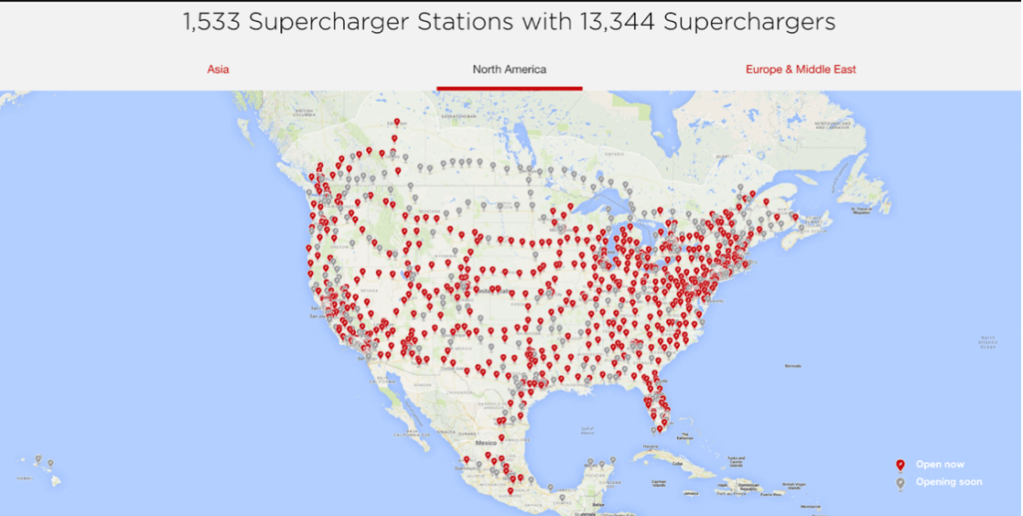
Even so, the Tesla Supercharger Network pictured below has expanded greatly since its inception, growing from just 8 charging stations in the U.S. in 2013 to 1,130 in 2019. This should alleviate any potential buyers concerns that they may have trouble finding charging stations on long road trips when they can’t charge at home.
A close up of a map

Description automatically generated

Professor Kent Golden from Quinnipiac University owns a 2018 Tesla Model 3 performance version, and can speak to the cost benefits of owning a fully electric car. 

“Every year, Tesla owners wind up saving about $1,000 on average, just in fuel savings. Because electricity, especially if you charge at night, is just way less expensive than gasoline. And gasoline is pretty cheap right now,” he said. 

Added on to the savings in energy spending is that there’s virtually no maintenance to the car either. “There’s no oil changes, there’s no radiator fluid, there’s no belts, no pulleys. There’s none of that stuff that goes wrong with an internal combustion engine,” Professor Golden added.

Richard Jordan, the President of the Tesla Owner’s of Connecticut Club, has had a Model S for nearly six years and loves the savings in electricity cost, but he also appreciates escaping the chore of going to get gas every week.

“It’s the chore of having to do it. Right now, what is it, 15 degrees outside? Right now my cars charging in the garage. You come home, you plug in and scurry inside. The car will take care of itself,” Jordan said. 

——–

There’s a common thread here intertwined between Tesla and Apple. Both are ambitious technological companies pushing the boundaries of their products and creating new norms. 

Tesla is far ahead of its electric car competition for more reasons than just energy efficiency. The brand as a whole is well-rounded, dynamic, and fun to be a part of. Owning a Tesla is similar to owning an Apple product in that it is a personalized, high tech product pioneering an evolving technological revolution that’s taking place on roadways everywhere rather than in our hands. 

The unveiling of the design of the Tesla Cybertruck prove that Tesla as a brand is self-aware. They know that they are the future of the car industry, which is why they made a design so strikingly futuristic in its nature. 

What is yet to be determined is whether or not competing car brands will ever be able to offer not only a similar product, but a similar attraction to their brand that consumers have to Tesla. Comparable to the pull that iPhone’s have over android, Tesla may have already accelerated too far ahead of their competition to ever be caught. Considering the Cybertruck accelerates faster than a Porsche 911, this wouldn’t be surprising in the least. 


Long-form Summary

The overarching purpose of my article is to tell the story of my brother’s journey from quitting his full-time job to become a full-time Amazon reseller and entrepreneur. I want to focus on his path both mentally and physically that led him to this decision, detailing what events and aspects of his prior job led him to the decision that he made and what his vision is for the future. Not only did my brother quit his job in NYC, but he is now moving to Florida as he continues to find shape his professional and personal goals.

I want this to be a human-interest story telling piece, however, aspects of this may prove challenging because the story does not yet have an end. Even so, I think I have a lot of material to work with and am confident that interviewing my brother will help me craft my article into a more well-rounded piece with a clear focus. Getting quotes from my brother and hearing the story through his perspective will help give my article direction and clarity. 

David Sheets Long-form Reflection

David Sheets

2/16/20

Professor Wortman

            The long-form piece “Steve Kerr is the King of Cool: Drama X Joy X Defeat = Destiny on Repeat” by Erik Malinowski from Bleacher Report is one of my favorite long-form pieces in the sports genre. Malinowski does a great job of capturing the essence of all things Steve Kerr, from his attitude, work-ethic, personality, playstyle and coaching philosophies. Kerr is one of the most well-respected coaches in the NBA after his long tenure as an NBA player. He was a sharpshooter on three Chicago Bulls championship teams alongside Michael Jordan, as well as a two-time champion on the San Antonio Spurs. Throughout the article, Malinowski details Kerr’s rise to the NBA alongside the support of his father. He begins by describing the relationship Steve Kerr had with his father, Malcolm Kerr, and how that helped shape Steve as a player and eventual coach. Malinowski’s writing style and word choice in describing Steve Kerr and his father is strong. He conveys the personality of both individuals in an emotional and enduring way that captures both Steve and his father’s similar attitudes.

He describes Steve Kerr’s father, Malcolm, as a “worldly man, capable of disarming you with a smile before systematically picking apart your argument. When Kerr spoke, he compelled others to listen.” Malcolm Kerr commanded peoples respect and did so with a smile. In many ways, Malinowski describes, Steve Kerr has continued his father’s legacy. “Kerr maintains his father’s smile, preaching the gospel of joey whenever he can, but there’s a competitive fire in him that’s been forged by the greatest success and the most painful loss.” This competitive fire materialized after the unexpected murder of his father on January 18, 1984. Steve was awoken to the news of his father’s death at 1:30 a.m. by a family friend. His father had been killed by two assassins outside of his office in Lebanon. Steve decided that the best way to cope with his father’s loss was to continue playing basketball, fueling his competitive fire. “I felt like the best thing to do was just to play, get away from it,” Kerr said. It turns out Steve was right, swishing his first two baskets in his first game back for Arizona. He ended the game with a career high 12 points and Arizona won the game 71-49.

 Malinowski continues describing Kerr’s self-deprecating, yet calm and confident personality, “he is self-effacing, even though his body has been giving out on him since he was 20. He is a convincing strategist without being a jerk about it.” This description of Steve sounds a lot like that of his father, and it’s a huge aspect of his success as a player and coach. “Part of who I am,” Kerr said to B/R Magazine, “is just finding the humor and the irony in the bullshit that exists in the world and our everyday lives. We try to exploit that and have fun.” This snippet into Kerr’s coaching style is easy to see on the court. Not only did he help coach the Golden State Warriors to two championship titles, three finals appearances in a row, and the best regular season record of all-time, but the joy his players have on the court is obvious even on the television screen. Kerr’s offense is fluid, the ball constantly moving and players unselfishly buying in to this system. Anyone who has consistently watched basketball for the past few years has likely seen incredibly unselfish strings of plays from the Warriors where the ball moves around between teammates like a hot potato, only to find a shooter like Steph Curry wide open and celebrating an easy bucket.

The Warriors have fun when they play, which was a large reason why Kevin Durant decided to join forces with them after leaving Oklahoma City. Malinowski continues doing a great job of drawing parallels between the attitude Kerr learned from his father and the style of coaching he implements on the Warriors players. “Looking for panic in Kerr’s face is a waste of time, because there’s that comforting squint around the edges of his eyes when he smiles at you. No desperation here. Just the gospel: ‘We make fun of each other,’ [Kerr] says. ‘We make fun of ourselves and try to laugh and keep it light.” Malinowski continues, ‘Some of that outlook comes from his dad, but Kerr has refined a persona of eminent calm- a gravity amid the chaos… This is who Steve Kerr is: Driven by anger and ebullience, with good humor to spare, in one of America’s most high-pressure professions, his life has been defined by impossible choices every which way.”

In short, this long-form piece is one of my favorite because Malinowski does not hold back on his writing style. He has a clear, distinct voice in his writing that does a great job of complimenting Steve Kerr and his father’s portrayed personalities. His vivid descriptions take the reader on a journey through Steve’s life and leave few stones unturned. By the end of his article, the reader leaves with a strong understanding of Steve Kerr the player, the coach and the man as influenced by his father Malcolm. It details the emotional and physical turmoil Steve has endured and how he used that to his benefit, even if self-deprecating at times. This article offers the reader a vivid, holistic and honest approach into the complicated life of “The King of Cool” Steve Kerr.

Zinsser Chapter 5 Reflection

David Sheets

Professor Wortman

2/16/20

To be quite frank, I am pleasantly surprised by William Zinsser’s message to writers in Chapter 5 of On Writing Well. While you might find a variety of opinions from different writers regarding whether or not to consider your audience when writing, Zinsser’s message remains consistent. “You are writing for yourself,” he asserts. He suggests to the reader not to “try to visualize the great mass audience,” because every reader is a unique individual with different expectations. With this advice, Zinsser is trying to help the writer narrow his microscope in on his own writing style and voice. He wants the writer to influence what he has control of and let the chips fall where they may.

I find this advice fundamentally valuable as an aspiring journalist because it can be easy to lose your voice in your writing in an attempt to appeal to a broader audience. I often find myself holding back on certain aspects of my writing that Zinsser would likely tell me to embellish on. He continues, “don’t worry about whether the reader will ‘get it’ if you indulge in a sudden impulse of humor. If it amuses you in the act of writing, put it in” (24). Zinsser’s message here is duly noted and a great point. It all goes back to writing for yourself and finding your voice. Injecting humor and/or any bit of personality into your writing when you feel the urge to do so can be a great way of separating yourself from other writers. It can also help you hone in on your writing style. He emphasizes that this tinge of personality in your writing can always be revised, taken out or altered later, but only you can put them in. Zinsser wants the writer to take chances and have fun, because, if you’re having fun writing the reader is more likely to be having fun reading. He is urging the writer to have fun while writing because that is what connects a great writer with his/her audience. Zinsser thinks that if you be yourself, enough people will flock to your writing that enjoy your style as well. “If you lose the dullards back in the dust,” Zinsser says, “you don’t want them anyway” (24). He is emphasizing being yourself while writing because you will have a greater chance of creating a meaningful audience that enjoys a writing style that only you can create.

Zinsser admits that his advice can seem paradoxical, for in early chapters he likened the reader to an “impatient bird, perched on the thin edge of distraction or sleep”. Yet, he separates these two points into two different issues: craft and attitude. With respect to writing craft and his perched bird metaphor, Zinsser is simply emphasizing the importance of the “workmanship” of your writing. He describes the reader as “impatient” in that they are not likely to stick with your piece if it has a number of grammatical or technical errors within it. Zinsser wants the writer to be themselves while keeping in mind the professional integrity of their article. Doing so will help the reader immerse themselves into your writing and trust that your piece is worth reading from beginning to end. By ensuring the structure of your writing is strong at its core, the reader will have less excuses to move on without finishing.

Zinsser’s message throughout chapter 5 is clear: be yourself and write for yourself. If you be yourself, Zinsser argues, a writing style and distinct voice will “[emerge] from under the accumulated clutter and debris, growing more distinctive everyday” (25). He emphasizes that finding your voice may take time, just as finding yourself as a person takes time. A voice in your writing will grow alongside your growth as a human but it will only come from being yourself while writing and taking chances. Furthermore, he wants the writer to write for himself because that is how the best writers separate themselves. A writing style and voice may take time to develop, but once it does, you will have created something uniquely your own. Write for yourself, and the rest will come naturally.

Political Journalism: Bias in Opinion Pieces

News media bias appears to be running rampant within major American news organizations across the political spectrum. The nature of the bias is most concerning within opinion articles that appear to make fact-based claims. I am choosing two Fox News opinion articles as a means of comparing and contrasting good and bad journalistic writing. 

Gregg Jarrett of Fox News posted an article on January 15th entitled “Pelosi’s sham impeachment is abuse of power for political gain.” The title of this piece is immediately provocative. While admittedly an opinion piece, the suggestion that anyone knows what Nancy Pelosi’s true intentions are is far-fetched. 

The article goes on to make a number of claims about Speaker Pelosi that are highly disputable – even making assertions about her inner intent behind moving forward with President Trump’s impeachment.

“Pelosi doesn’t care about facts, evidence, or what constitutes an impeachable offense under the Constitution. She cares only about bludgeoning the president for the electoral harm it might cause him in November,” Jarrett says.

He continues, “This has been Pelosi’s intent all along. Impeachment was her political cudgel. She crowed about it like a pro wrestler who body slams an opponent and then celebrates by prancing around the ring. It was all staged, of course”.

The lack of evidence to back up these assertions is the most concerning aspect of this article. Fox News opinion writers have the right to disagree with Speaker Pelosi’s impeachment process. However, this piece makes a number of claims about Speaker Pelosi’s intent that remain unproven. These critiques about Pelosi’s character are not backed up with evidence within Jarrett’s article. In order to write a fair journalistic piece, any assertions should be backed up by a foundation of facts. In this aspect, Jarretts article is lacking greatly. 

In an attempt to fairly compare and contrast good and bad journalistic writing, I am choosing another Fox News opinion article as an example of a well-written piece. Deroy Murdock recently posted an article entitled “Trump Senate trial — Democrat impeachment managers voted AGAINST military aid to Ukraine”. The title of this article is more well-rounded than the prior piece because it states a fact that is later proven by the author – rather than stating an opinion that cannot be verified. Murdock continues by criticizing the manner in which Democrats have been attacking President Trump for his reluctance to give military aid to Ukraine. He points out the hypocrisy, citing multiple instances in which Democrats rejected military aid to Ukraine themselves.

He describes how, on July 26, 2018, [House Democrats Nadler, Lofgren, and Jeffries] voted against the Fiscal Year 2019 National Defense Authorization Act, which included $250 million in security assistance to Ukraine.” This article gives a fairer critique of House Democrats when contrasting it to the prior article by Jarrett for it brings up real-world evidence to defend its claims. Murdock is shedding light on the House Democrats who have rejected military funding to Ukraine while subsequently criticizing President Trump for doing the same. As the reader, it is fair to disagree with Murdock’s conclusions in this article. What this piece has that the prior article is lacking, however, is a foundation of facts to build an opinion off of. For these reasons, I find Murdock’s opinion piece to be a more well-rounded journalistic article than Jarett’s.

David Sheets Professional Bio

David Sheets is an aspiring journalist looking to break into the sports media industry. He offers a relevant range of experience in digital sports reporting, writing, video editing, and radio production. He has interned for multiple professional media organizations in the journalism field including WGCH Greenwich Radio where he helped produce a weekly radio talk show. He also gained on-air experience during this internship, speaking frequently on-air with the host Mary Anne Defelice and her many guests.

David also has professional experience producing and editing digital video content for political and sports social media pages. He has worked with pages like SoapBox Politics, KnicksFanTV, and the Knick of Time Show to produce a variety of digital content including video interviews and written articles. He has also helped to distribute content for a variety of different platforms, including the production of the KnicksFanTV podcast. 

David is motivated to thrive in the sports media industry and is currently expanding upon his experience by pursuing a Masters degree in Journalism from Quinnipiac University.

Design a site like this with WordPress.com
Get started